
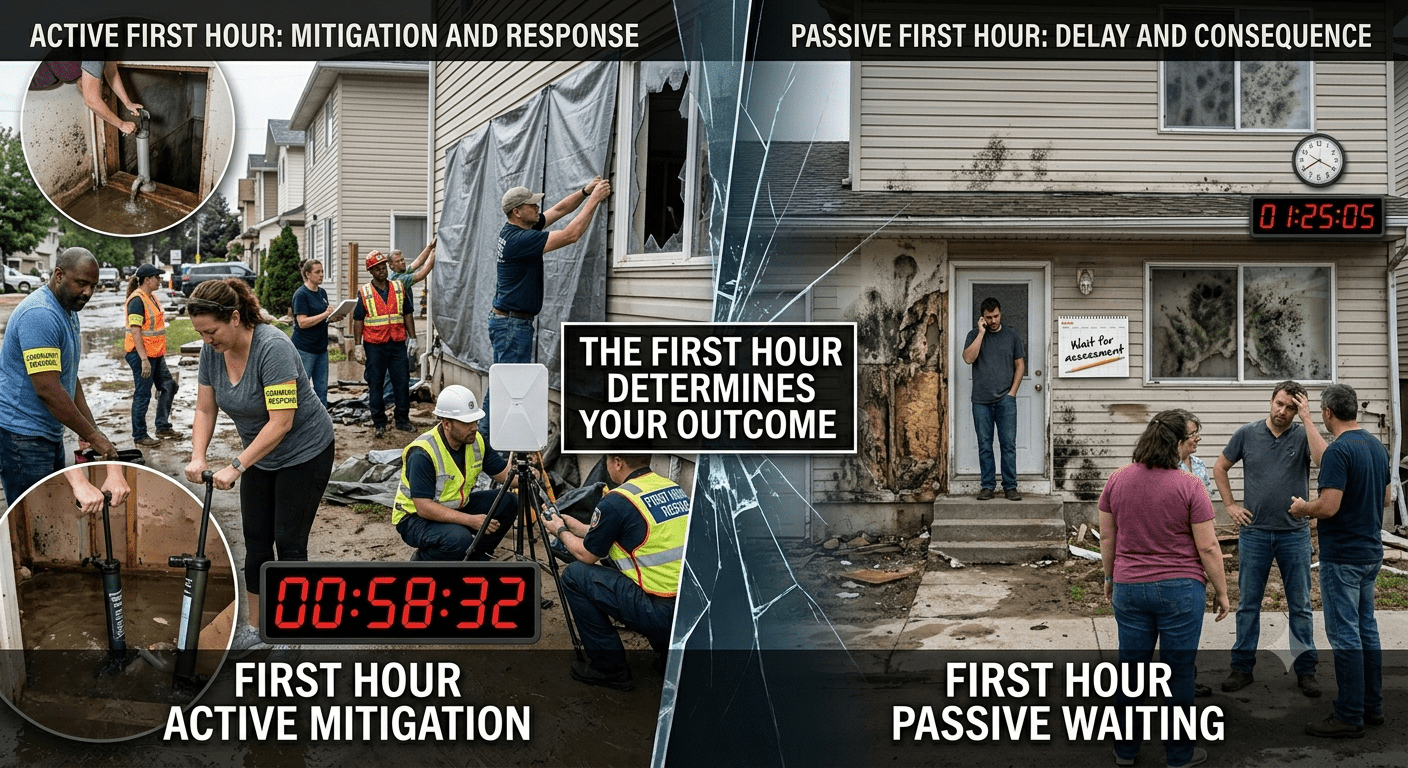
The Critical Window Most Property Owners Underestimate
When disaster strikes a home or business, whether it’s a burst pipe, an electrical fire, or storm damage breaching the roof, the instinct for most people is to assess the situation, make a few phone calls, and figure out next steps over the following day or two. This instinct, while understandable, works directly against the property owner’s interests. The first hour after any disaster event is the single most important window for limiting damage, controlling costs, and setting the trajectory for the entire restoration process. Understanding why this window matters so much can change how quickly a property owner picks up the phone when disaster strikes.
Water Damage Multiplies Exponentially, Not Linearly
Standing water doesn’t sit still. It spreads through gravity and capillary action, soaking into flooring, climbing walls, and seeping into adjacent rooms within minutes of an initial release. A burst pipe that floods a single room in its first ten minutes can, without intervention, affect three or four adjoining spaces within the first hour as water finds paths through flooring seams, under walls, and into lower levels. Every additional minute water sits expands the affected square footage and increases the volume of saturated material that must eventually be dried, treated, or replaced. Emergency restoration services dispatched immediately can extract standing water and begin structural drying before this spread reaches its full potential, often containing the damage to a fraction of what it would become with delayed response.
Fire and Smoke Damage Continues Spreading After Flames Are Out
Smoke and soot particles remain airborne and continue settling onto surfaces throughout a structure for hours after a fire is extinguished. HVAC systems, if left running, actively distribute these particles into rooms that may not have been directly affected by the fire itself. Acidic soot residue becomes more difficult to remove the longer it sits on surfaces, particularly on metal fixtures and electronics, which can experience corrosion damage within hours if soot isn’t addressed promptly. Emergency response teams arriving within the first hour can shut down HVAC circulation, begin protective measures for unaffected areas, and start the soot removal process before residue has a chance to chemically bond with surfaces, which becomes significantly more difficult and costly to reverse after even a single day.
Mold Growth Timelines Make Speed Non-Negotiable
Mold spores require roughly 24 to 48 hours of sustained moisture to begin colonizing a surface. This means the response window following any water-related disaster isn’t measured in days, it’s measured in hours. Emergency restoration services that arrive and begin extraction and drying within the first hour are working to beat this biological clock entirely, potentially preventing mold colonization from ever starting. Response that’s delayed by even a day pushes the restoration timeline past the point where mold prevention is realistic, shifting the project from straightforward water extraction and drying into a combined water and mold remediation project with significantly higher cost and complexity. This single biological fact is why emergency response speed has such an outsized impact on total restoration cost and timeline.
What Professional Emergency Response Actually Accomplishes in Hour One
A professional emergency response team arriving within the critical first hour performs several actions simultaneously: stopping the source of ongoing damage where possible, extracting standing water or removing fire debris, documenting the full scope of damage for insurance purposes before any further deterioration occurs, deploying drying equipment or protective covering immediately, and assessing structural safety to determine whether any areas require immediate stabilization. This rapid, comprehensive response sets a foundation that affects every subsequent phase of restoration. Properties that receive this immediate intervention consistently experience shorter overall restoration timelines, lower total costs, and fewer secondary complications than properties where response was delayed even by a single day.
Building a Response Plan Before You Need One
The most effective way to take advantage of the critical first hour is having a restoration company identified and contact information accessible before disaster strikes, not searching for one while water is actively spreading through your home. Property owners and managers across Zionsville and Central Indiana benefit from establishing a relationship with a 24/7 emergency restoration provider in advance, particularly commercial property managers responsible for multiple buildings where disaster response planning is part of standard operational preparedness. Having this resource already identified eliminates the time lost to searching for help during the highest-stress moments of a disaster event, ensuring that the critical first hour is spent on actual mitigation rather than on finding someone who can respond.
Questions Homeowners Ask
| Why does response time matter so much for water damage? | Water spreads exponentially through flooring and walls within minutes. Mold can begin colonizing within 24 to 48 hours. Fast response contains the affected area and can prevent mold growth from starting altogether. |
| What should I do in the first minutes after a disaster? | Stop the source of damage if safely possible, such as shutting off a water valve, then call a professional emergency restoration team immediately rather than waiting to assess the full situation yourself. |
| Does fast response really lower total restoration costs? | Yes. Properties receiving immediate professional intervention consistently see shorter restoration timelines, lower total costs, and fewer secondary complications compared to properties with delayed response. |
| Should I have a restoration company identified in advance? | Yes, especially for commercial property managers. Having a 24/7 emergency restoration provider identified in advance eliminates time lost searching for help during a disaster, preserving the critical first hour for actual mitigation. |




0 Comments