
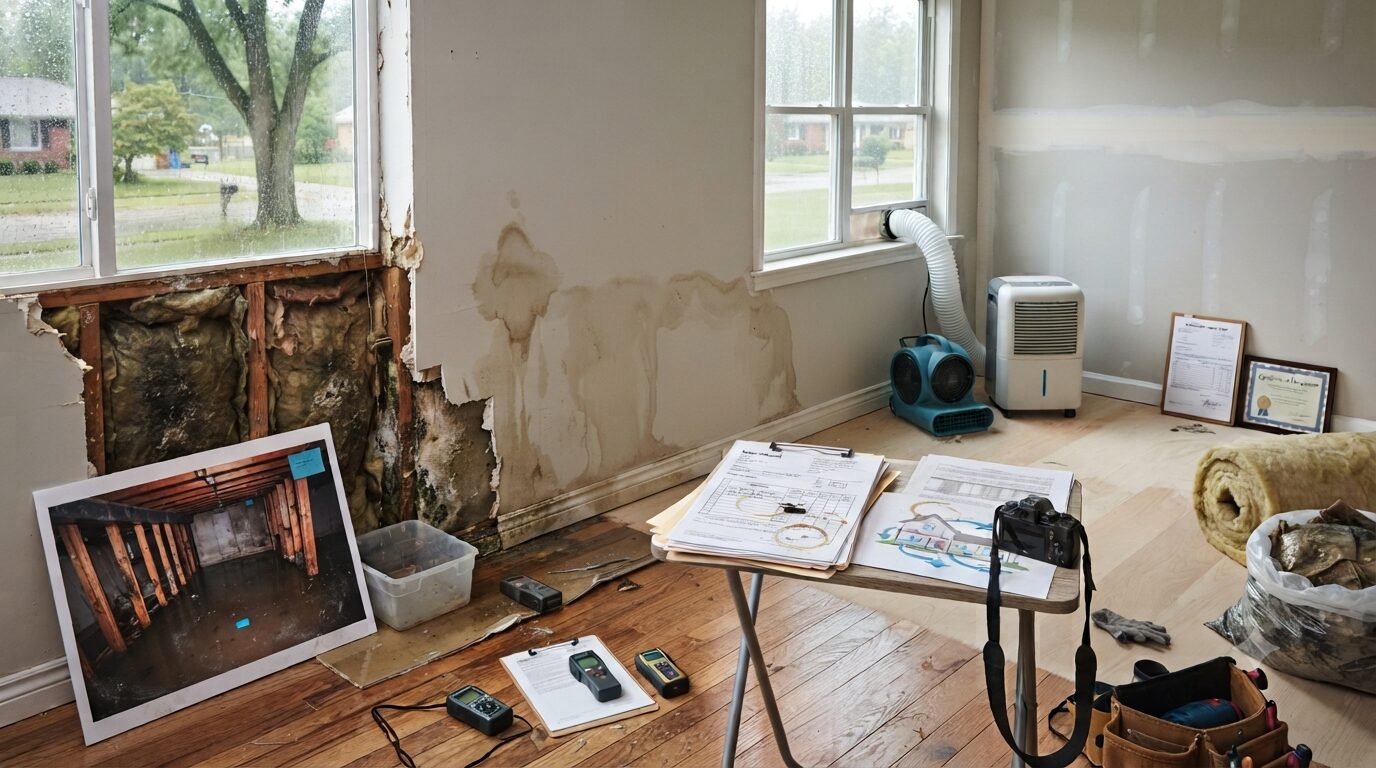
Most property owners go through a significant insurance claim once or twice in a lifetime, while the adjuster on the other side of the table handles them every day. That experience gap is where claims lose value: scope items missed because the owner did not know they were claimable, documentation gaps that give the carrier grounds to reduce, and timeline mistakes that complicate coverage. Understanding the sequence, the roles, and where the leverage points are levels the field.
Step One: Notice of Loss and What It Starts
The claim begins when the loss is reported to the carrier, which should happen the day of the event. Prompt notice is a policy condition, and it establishes the date of loss that the entire claim references. The carrier assigns a claim number and an adjuster. For widespread events, storms that produce hundreds of simultaneous claims, adjuster assignment can take days, which is why the property owner’s own documentation from day one carries so much weight.
Emergency mitigation does not wait for the adjuster. Policies require the owner to prevent further damage, and emergency extraction, board-up, and drying are covered mitigation expenses. Restorm Indy’s emergency restoration services begin this covered mitigation work immediately while documenting pre-mitigation conditions thoroughly, so nothing the mitigation changes is lost to the claim record.
Step Two: Documentation Builds the Claim
The claim settles on what can be proven. Pre-mitigation photographs and video, moisture maps, itemized damage inventories, and daily work logs are the evidence base. The difference between a complete claim and a reduced one is usually not disagreement about what happened; it is whether what happened was documented before conditions changed.
Restoration scope documentation is written in estimating formats the carrier’s systems recognize, itemized by trade and line item. A restoration contractor who prepares scope in this format, as Restorm Indy does for water damage restoration and fire damage restoration losses, shortens the negotiation because the adjuster reviews line items rather than translating a narrative estimate into their system.
Step Three: The Adjuster Inspection
The adjuster inspects to verify the loss and build the carrier’s own scope. Walk the loss with them, or better, have the restoration contractor present, because scope disagreements are resolved most efficiently in the room where the damage is visible. Hidden damage, moisture inside assemblies, smoke migration beyond the visible area, is where owner-only inspections lose value: the adjuster scopes what is shown, and the contractor is the one who can show the thermal imaging and meter readings that prove the hidden extent.
The adjuster’s initial estimate is a starting position, not a verdict. Supplements, additional scope discovered as work opens assemblies, are a normal part of the process, not a dispute. Carriers expect them. What supplements require is the same documentation discipline as the original claim: photos of the newly discovered condition before it is repaired.
Step Four: Payment Structure and Depreciation
Most Indiana property policies pay replacement cost in two stages: an initial actual cash value payment that deducts depreciation, and a recoverable depreciation payment released when the work is completed and documented. Owners who do not complete the work, or do not submit completion documentation, leave the depreciation unrecovered. Mortgage lenders are typically named on structure payments and have their own endorsement and inspection procedures that add days to fund access; starting that process early prevents it from stalling the reconstruction schedule.
Where Claims Go Wrong
- Cleanup before documentation, erasing evidence the claim needed
- Discarding damaged contents before they are inventoried, removing them from the claim entirely
- Accepting the initial estimate as final rather than as an opening scope subject to supplements
- Missing recoverable depreciation by failing to submit completion documentation
- Letting an unqualified contractor’s incomplete scope define the claim
- Signing assignment agreements or contracts under pressure without review
Disputed Claims
When a genuine dispute develops, scope, cause, or amount, Indiana policyholders have escalation paths: supplement negotiation with documentation, appraisal clauses in most policies that provide a structured resolution process, the Indiana Department of Insurance consumer complaint process, and for large commercial losses, public adjusters or counsel. Most disputes resolve at the documentation stage, which is another way of saying most disputes are prevented by the records kept from day one. Restorm Indy’s role in contested claims is producing the technical record, moisture logs, thermal images, photo documentation, and scope detail, that the resolution process runs on, and its construction and contracting scope carries the claim documentation through reconstruction to the completion certificate that releases final payment.
Frequently Asked Questions
Q: Should I wait for the insurance adjuster before starting cleanup?
A: No. Policies require the owner to mitigate further damage, and emergency work, extraction, board-up, drying, is covered and expected before adjuster arrival. What must precede the mitigation is documentation: photograph and video everything before conditions are changed. Permanent repairs, as opposed to emergency mitigation, should wait for adjuster review of the scope.
Q: What is recoverable depreciation on an Indiana property claim?
A: Replacement cost policies typically pay in two stages: an initial payment reduced by depreciation, and a second payment releasing that depreciation when the repair work is completed and documented. The depreciation is recoverable only if the work is done and completion documentation is submitted within the policy’s time window. Owners who pocket the first payment without completing repairs forfeit the depreciation portion.
Q: What is a supplement on an insurance claim?
A: A supplement is additional scope submitted after the initial estimate, typically for damage discovered as work opens walls, floors, and ceilings that could not be fully inspected at the initial adjustment. Supplements are a normal, expected part of restoration claims, not a dispute. They require the same documentation as the original claim: photographs of the newly discovered condition before repair, and line-item scope in the carrier’s estimating format.
Q: Can my restoration contractor talk to my insurance adjuster directly?
A: Yes, and it usually helps. The contractor holds the technical documentation, moisture readings, thermal images, and scope detail, that answers adjuster questions accurately. The property owner remains the policyholder and decision-maker; the contractor handles technical communication. This is different from an assignment of benefits, which transfers claim control to the contractor and should not be signed without careful review.
Property damage claim in Indianapolis, Carmel, Fishers, Avon, Zionsville, Whitestown, or Lebanon? Restorm Indy documents, scopes, and communicates with your carrier from day one. Call now.






0 Comments