
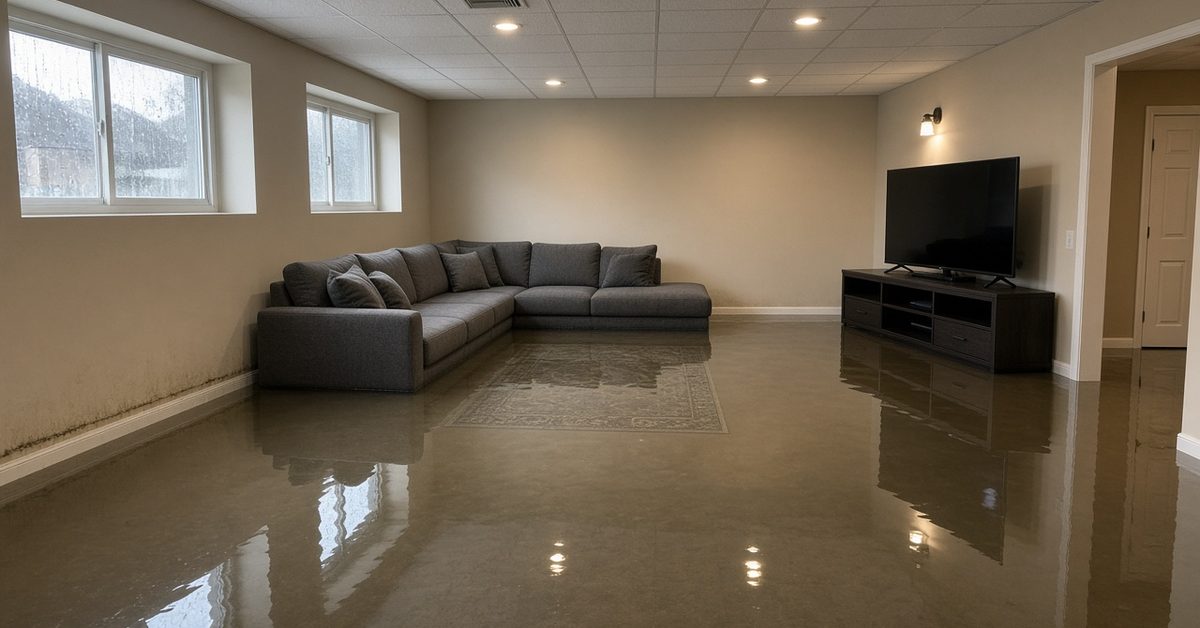
Spring in Central Indiana brings a lot of rain, often in short bursts that drop more water than the ground can absorb. For homeowners in Avon, Whitestown, and the growing neighborhoods around Indianapolis, that’s when basements start taking on water.
Whether it’s a trickle along one wall or several inches across the floor, basement water needs attention fast. Here’s how storm water gets in, what to do first, and how the basement gets back to normal.
How Storm Water Gets Into a Basement
- Sump pump problems. The pump fails, loses power during the storm, or simply can’t keep up.
- Saturated soil. After days of rain, water builds up around the foundation and pushes in through cracks or the joint where the floor meets the wall.
- Window wells fill up when their drains clog, then leak around the window.
- Gutters and downspouts that overflow or dump water right next to the house.
- Grading that slopes toward the foundation, which is common in newer subdivisions as soil settles.
- Floor drain backups when the municipal system is overwhelmed.
First Steps
- Cut the power to the basement if water is near outlets, extension cords, or appliances.
- Check the sump pump. If it’s safe, make sure it has power and the float isn’t stuck.
- Move belongings off the floor and out of the water.
- Photograph everything before cleanup starts.
- Call a restoration team. Our emergency restoration services are available around the clock, including during storms.
What Restoration Involves
The goal is to get water out and get the structure dry before damage spreads. Professional water damage restoration starts with extracting standing water using truck-mounted or portable pumps. Then the team maps moisture across floors and walls.
In a finished basement, wet carpet pad is usually removed, and drywall is cut above the water line so insulation and framing can dry. If the water came from outside or from a floor drain, it’s treated as contaminated, which means more materials have to come out and surfaces get cleaned and disinfected. Dehumidifiers and air movers run until moisture readings are back to normal. Basements dry slower than upstairs rooms, so monitoring matters.
Fixing the Cause
Drying the basement without addressing the source just sets up the next flood. After the job, it’s worth looking at:
- Adding a battery backup sump pump
- Extending downspouts several feet from the house
- Cleaning or covering window wells
- Regrading soil to slope away from the foundation
- Sealing foundation cracks
- Installing a backwater valve if the floor drain backed up
Insurance Tips
Coverage for basement water depends on the source. Water from a failed sump pump or a sewer backup is often excluded unless you have a water backup endorsement. Surface water from outside is usually considered flood, which needs a separate flood policy. It’s worth reviewing your coverage before the next storm season.
Rebuilding
Once the basement is dry, drywall, insulation, trim, and flooring are replaced. It’s also a good moment to choose materials that handle future water better, like luxury vinyl plank instead of carpet.
Frequently Asked Questions
How fast should I get water out of my basement?
As fast as possible. The first 24 to 48 hours matter most. Water that’s extracted quickly and followed by professional drying often means carpet, drywall, and trim can be saved. Water that sits for days usually means more materials have to be removed.
Can I use a shop vac for a flooded basement?
A shop vac can help with small amounts of water on hard floors, but it can’t pull water out of carpet pad, drywall, or wall cavities. For more than a small puddle, professional extraction and drying equipment is the way to go.
What if my basement floods every spring?
Repeated flooding usually points to a drainage issue around the house: downspouts, grading, window wells, or foundation cracks. A backup sump pump, interior drain tile, or crack repair can solve many chronic problems. It’s worth addressing the cause after this season’s cleanup.
Is storm water in the basement covered by insurance?
It depends on how it got in. Sump pump failure and sewer backup usually require a water backup endorsement, and surface water from outside is typically considered flood. Review your policy with your agent before storm season.
Do I need to replace drywall after a basement flood?
If water soaked the bottom of the drywall, the lower section and the insulation behind it usually need to be cut out so the wall cavity can dry. Drywall that stays wet loses strength and can stain or crumble. If the water was contaminated, affected drywall is always removed rather than dried in place.
Should I call a plumber or a restoration company first?
If water is still coming in from a pipe, call a plumber to stop it. If the water came from a storm, a failed sump pump, or seepage, call a restoration company first to start extraction. In many cases, it’s best to call both right away.
Here During Storm Season
We respond to flooded basements across the west and northwest side, including Avon and Whitestown. If your basement is taking on water, call Restorm at (317) 995-6696, day or night.





0 Comments