
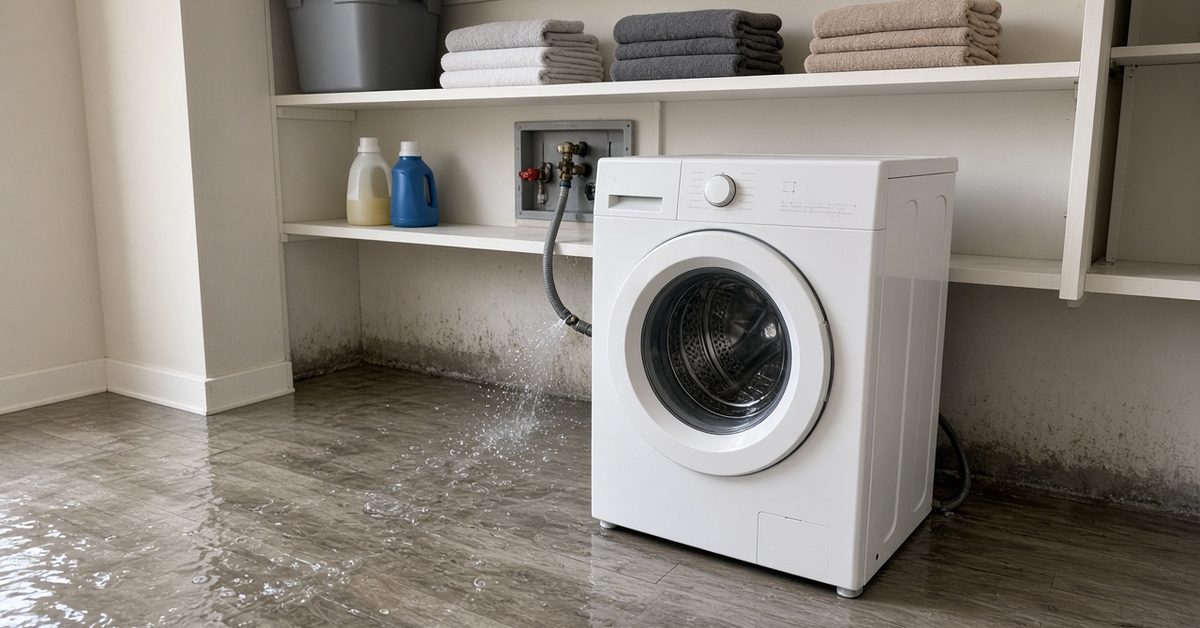
Many newer homes in Carmel and Fishers put the laundry room upstairs near the bedrooms. It’s a smart layout. Nobody misses hauling baskets up and down the stairs. But it also means the washing machine, with its water supply hoses and drain, sits directly over the kitchen, the living room, or the foyer.
When something goes wrong with an upstairs washer, water heads straight down through the house. Here’s why it happens, what to do in the first few minutes, and how the damage gets properly repaired.
How Upstairs Washers Leak
- Burst supply hoses. Rubber hoses weaken with age and can split under full water pressure. They can release a lot of water fast.
- Loose or cracked fittings at the hose connections.
- Drain hose problems. A hose that pops out of the standpipe or a clogged drain that overflows during the spin cycle.
- Overflowing drain pans. Many upstairs laundries have a pan under the washer, but the pan drain can clog or the pan can be overwhelmed.
- Machine failures, like a failed door seal or pump.
Where the Water Goes
The laundry room floor usually has vinyl or tile over a wood subfloor. Water spreads across the floor, gets under the flooring, and seeps through the subfloor into the space between floor joists. From there it lands on the drywall ceiling of the room below.
It often spreads sideways before it drips, so the first sign might be a stain or a drip in a room next to the one under the laundry. Water also runs down the walls around the laundry and into the first floor, soaking drywall, baseboards, and flooring. In homes with a finished basement, it can travel down another level.
What to Do Right Away
- Turn off the water at the valves behind the washer. If you can’t reach them or they won’t turn, shut off the main.
- Unplug the washer or shut off the breaker.
- Turn off power to ceiling lights or fans below if water is near them.
- Move furniture and electronics out from under the wet ceiling.
- Stay out from under sagging drywall.
- Take photos of the washer, the laundry floor, and every affected room below.
Then call for help. Fast emergency restoration services can get water extracted and drying started before it spreads further.
Why You Can’t Just Let It Air Dry
The space between floors is enclosed, so air can’t reach the wet subfloor, joists, and insulation. Ceiling drywall that holds water can sag, lose its bond with the framing, or crack along the seams later. Flooring upstairs can lift or buckle as the subfloor swells.
Professional water damage restoration uses moisture meters and thermal imaging to find all the wet areas, not just the stains. Often that means small holes or removed sections in the ceiling below so the cavity can dry, removing wet insulation, pulling baseboards, and setting air movers and dehumidifiers until everything tests dry. Then the ceiling, walls, and floors are repaired and refinished.
Preventing the Next Leak
- Replace rubber washer hoses with braided stainless steel ones, and replace them every several years.
- Make sure the drain pan has a working drain line.
- Add a leak sensor in the pan, or an automatic shutoff valve for the washer.
- Don’t run the washer when nobody is home.
- Leave a few inches between the washer and the wall so hoses don’t kink.
Frequently Asked Questions
How often should washing machine hoses be replaced?
Many manufacturers and plumbers recommend replacing supply hoses about every five years, even if they look fine. Braided stainless steel hoses last longer and resist bursting better than plain rubber, but they still wear out over time.
Does a drain pan under the washer really help?
Yes, as long as it has a working drain line. A pan catches small leaks and slow drips before they reach the subfloor. It won’t stop a burst hose running at full pressure, which is why an automatic shutoff valve or leak sensor adds another layer of protection.
Will my ceiling downstairs need to be replaced?
Not necessarily. If the drywall is still firm and was only wet briefly, it can often be dried in place with small access holes. Ceilings that sag, crack, or held water for a long time usually need sections replaced once the cavity above is dry.
Is upstairs laundry water damage covered by insurance?
Sudden leaks from a burst hose or machine failure are often covered under homeowners policies, minus the deductible. The washer or hose itself usually isn’t. Slow, long-term leaks can be harder to claim, so report damage right away.
Should I run the washer when nobody is home?
It’s safer not to. Most laundry leaks do the most damage when nobody is around to shut off the water. Running loads while you’re home and awake means a burst hose or overflow gets caught in minutes instead of hours, which can be the difference between a wet laundry room and two wet floors.
Help Nearby
We handle upstairs laundry leaks across Hamilton County and beyond, including Carmel and Fishers. If water is coming through your ceiling, call Restorm at (317) 995-6696. We answer 24/7.






0 Comments