
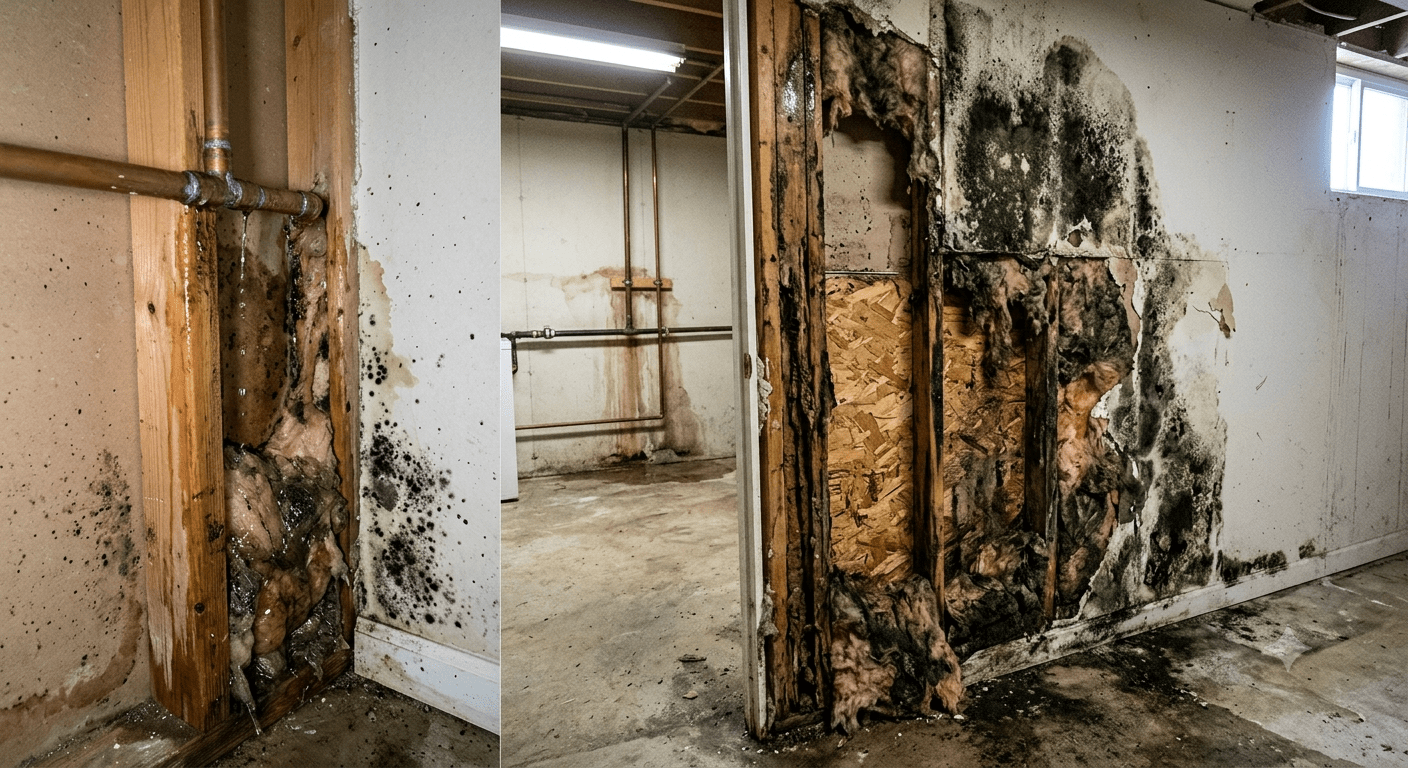
The Cascade Effect Most Homeowners Never See Coming
A single dripping pipe under a sink doesn’t look like an emergency. It looks like a minor annoyance, something to get to eventually. But water damage rarely stays contained to its starting point. It cascades. One small leak triggers a chain reaction of secondary problems that compound on each other, and by the time most homeowners notice the full scope, what started as a simple repair has become a structural and health crisis. Understanding this cascade effect is essential for any homeowner or property manager across Indianapolis and the surrounding communities, because the difference between catching a leak at hour one versus week three is the difference between a quick fix and a five-figure restoration project.
Stage One: The Invisible Saturation Period
Most slow leaks begin inside cabinetry, behind walls, or under flooring where they’re completely out of view. Cabinet bases, subflooring, and wall cavities absorb moisture continuously without any visible sign on painted surfaces. During this period, which can last anywhere from days to weeks depending on the leak’s severity, materials are quietly reaching saturation. Particleboard cabinet bases swell and lose structural integrity. Subflooring delaminates. Drywall paper backing begins absorbing moisture from the inside out, which means the surface can look completely normal while the interior structure is already failing. This invisible stage is the most dangerous because there’s no urgency signal prompting a homeowner to call for help. By the time discoloration or a musty smell appears, the saturation stage is already complete and the cascade has moved into its next phase.
Stage Two: Microbial Colonization Begins
Mold spores exist everywhere in ordinary indoor air. They’re harmless in normal, dry conditions because they need sustained moisture to germinate and colonize a surface. Once material has been wet for roughly 24 to 48 hours, conditions become favorable for spore germination. Hidden cabinet interiors, wall cavities, and subfloor areas affected by a slow leak typically stay damp far longer than that, sometimes for weeks, because there’s no airflow reaching these enclosed spaces to dry them naturally. This is precisely the environment mold needs. Colonies establish on cellulose-based materials like drywall paper, wood, and particleboard, and they spread outward from the original wet zone, following moisture gradients into adjacent dry areas through capillary action. A leak that started under a kitchen sink can produce mold colonization extending into the wall cavity behind the cabinet, into adjoining baseboards, and sometimes into the subfloor beneath neighboring rooms.
Stage Three: Air Quality Degradation and Health Symptoms
As mold colonies mature, they release spores and microbial volatile organic compounds into indoor air. These airborne particles circulate throughout the home via normal air movement and HVAC operation, exposing every room and every occupant to contamination that originated in one small, hidden area. Family members may begin experiencing symptoms they don’t connect to the source: persistent coughing, sinus congestion, headaches, fatigue, or worsening allergies. Children and individuals with asthma or compromised immune systems are particularly vulnerable to even moderate mold exposure. The frustrating part of this stage is that the symptoms are often vague enough to be attributed to seasonal allergies or a common cold, which means homeowners can live with degraded air quality for extended periods before connecting the dots back to a leak under a sink or behind a washing machine.
Stage Four: Structural Compromise and Escalating Repair Costs
By the time mold has been actively colonizing for a month or more, the structural materials it’s growing on have typically begun to break down. Wood framing affected by sustained moisture and fungal activity loses load-bearing strength. Subflooring becomes soft and spongy. Drywall loses its rigidity. What could have been a same-day plumbing repair and a quick drying job has now become a project requiring demolition of affected materials, professional mold remediation with containment protocols, structural repair or replacement of compromised framing, and full reconstruction of the affected area. The cost difference between stage one intervention and stage four remediation is often ten to twenty times greater, not including the disruption of having contractors in your home for weeks instead of days.
Breaking the Cascade Before It Starts
The single most effective way to stop this cascade is fast professional intervention at the first sign of water intrusion, even when the leak seems minor. Searching for water damage restoration near me at the first sign of trouble uses thermal imaging and moisture meters to identify exactly how far moisture has traveled beyond the visible wet area, ensuring that no hidden pockets are left untreated. Industrial dehumidifiers and air movers extract moisture from cabinet interiors, wall cavities, and subflooring before mold has the opportunity to establish. If colonization has already begun, mold removal after water damage safely contains the area, removes contaminated materials, and treats remaining surfaces with antimicrobial solutions before reconstruction begins. Homeowners and property managers throughout Indianapolis and the surrounding communities should treat every leak, however small, as a time-sensitive issue rather than a maintenance item to schedule for later. The cost of acting within the first day is always less than the cost of waiting.
Questions Homeowners Ask
| How fast can mold grow after a leak? | Mold spores can begin germinating within 24 to 48 hours of sustained moisture exposure. Visible colonies often appear within one to two weeks in enclosed, poorly ventilated spaces like cabinet interiors and wall cavities. |
| Can a small leak really cause major damage? | Yes. Small leaks left unaddressed cause cascading damage through saturation, mold colonization, air quality degradation, and eventual structural compromise. Early intervention prevents this chain reaction entirely. |
| What are signs of hidden mold from a leak? | Musty odors, unexplained allergy symptoms, discoloration on walls or cabinets, and soft or warped flooring near plumbing fixtures are all signs of hidden mold growth requiring professional inspection. |
| Why does intervention timing matter so much for cost? | Early-stage water extraction and drying costs a fraction of late-stage remediation, which requires demolition, containment, mold removal, and structural reconstruction. Acting within the first 24 to 48 hours dramatically reduces total cost. |



0 Comments